Professional Whitening That Actually Shows
You have been thinking about whitening your teeth for a while. Something made you finally search for it today, and that is a good sign. At Fountain of Youth Dental, Dr. Christopher Cappetta, DDS, has helped patients get noticeably whiter smiles for over 35 years. He starts every whitening case with an honest evaluation of what is actually possible for your specific teeth.
Patients from Castle Hills and Vance Jackson come in for whitening consultations every week because they want results that actually hold. Fountain of Youth Dental sits on Medical Dr in the primary corridor of San Antonio’s South Texas Medical Center, which means every whitening case is approached with the same clinical standard patients expect from a medical campus provider. Professional whitening and drugstore whitening are not the same process. They differ in gel concentration, tray fit, and how long the results hold.
Why Professional Whitening Works Better Than the Strips
Over-the-counter whitening products use hydrogen peroxide or carbamide peroxide at concentrations typically between 3 and 10 percent. Professional whitening gel runs significantly higher, which is why results appear faster and last longer. The American Dental Association confirms that professionally administered whitening uses higher-concentration bleaching agents applied under supervision, a distinction that matters for both results and safety.
Tray fit is the other variable most patients overlook. Generic strips and drugstore trays sit unevenly against your teeth, and uneven contact produces uneven results. Custom trays made from impressions of your specific teeth create consistent contact across every surface. Dr. Cappetta also checks for untreated cavities and gum inflammation before recommending whitening, a step that store-bought products skip entirely and that protects you from avoidable sensitivity.
What Causes Teeth to Stain and Yellow Over Time
Teeth stain in two distinct ways, and knowing which type you have matters for setting realistic expectations before you start treatment. Extrinsic staining builds up on the outer surface of your teeth from what you eat, drink, and do. Coffee, tea, red wine, dark berries, tomato-based sauces, and tobacco are the most common contributors. Professional whitening addresses this type of staining most effectively and consistently.
Intrinsic staining originates inside the tooth itself from tetracycline antibiotics taken during tooth development, fluorosis, or the natural process of aging as enamel thins over time. Intrinsic staining can improve with professional whitening, but results are less predictable. Patients with heavy intrinsic staining may find that porcelain veneers produce a better cosmetic outcome than whitening alone, and Dr. Cappetta will tell you honestly at the evaluation which category fits your situation.
What Happens at Your Whitening Appointment
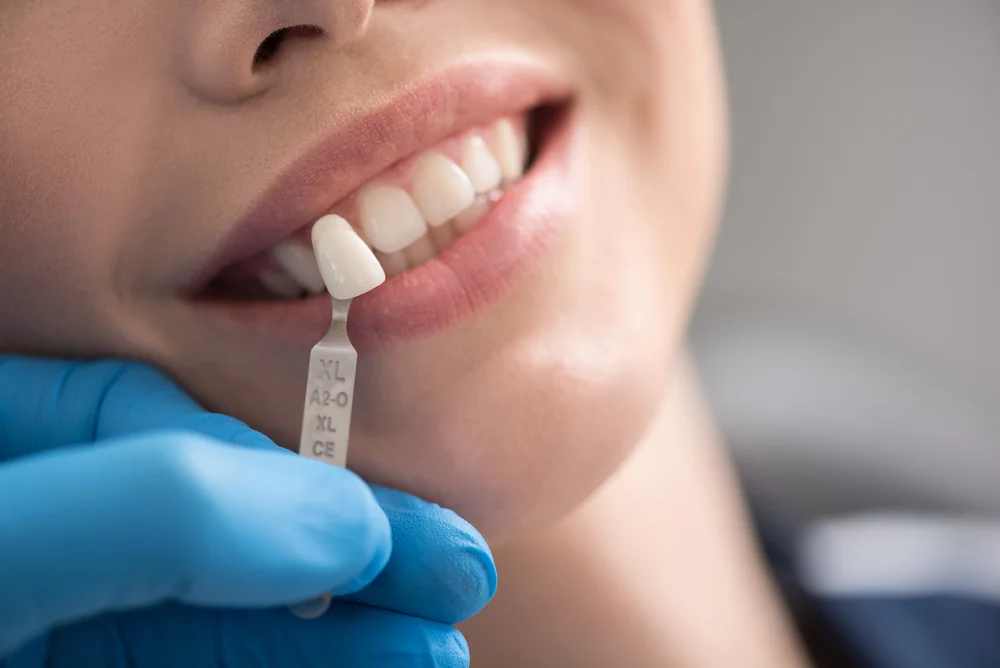
For in-office whitening, the visit begins with a shade assessment where Dr. Cappetta records your starting shade so you have a measurable baseline to compare at the end. Your gums and soft tissues are protected before any gel is applied, then the whitening gel is placed on the tooth surfaces and in some cases a light is used to activate the bleaching agent. The full session typically runs 60 to 90 minutes, and a shade comparison at the end shows exactly how much change occurred in one visit.
For custom take-home trays, the first appointment is used to take impressions of your teeth and fabricate trays that fit precisely. You return a few days later to pick up your trays along with gel and wear instructions tailored to your sensitivity level, and most patients complete their whitening course in 10 to 14 days at home. One important note after either treatment: avoid coffee, tea, red wine, and dark foods for the first 24 to 48 hours, as enamel pores are temporarily more open after whitening and teeth are more susceptible to restaining during that window.